Maximilian Held
Social Data ScientistI build reproducible, maintainable and scalable R data products.
I’m a freelance developer and full-stack data scientist with ten years of experience in open source, research and consulting.

I build reproducible, maintainable and scalable R data products.
I’m a freelance developer and full-stack data scientist with ten years of experience in open source, research and consulting.
(Data) scientists have a lot to learn from the technologies and conventions pioneered by the open source community. Conversely, data science is most powerful not in one-off scripts, but in productized analysis pipelines, that is, as software.
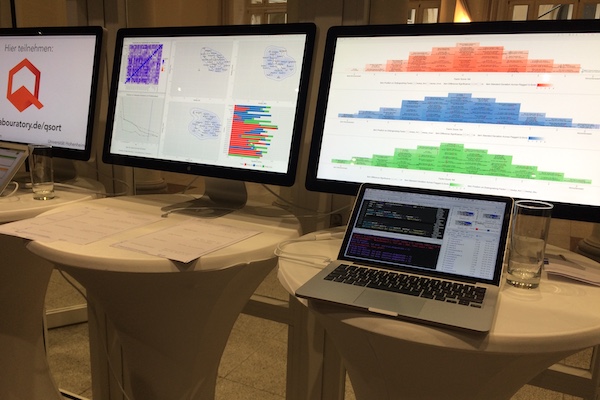
Subjective views are best measured not in surveys, but as ipsative choices among alternatives, such as in Q Methodology, Repertory Grid. I work on advancing these approaches with modern statistics and open source software.
Real participation, be it in an organisation or in politics, requires Communicative Action : the effective exchange of mutually comprehensible reasons. Cultivating and measuring deliberation is a hard, but worthwhile regulative ideal.
Alternatives such as a cashflow-based Progressive Consumption Tax, a Georgian Land Value Tax or auctioned Leaseholds promise to offer much more attractive tradeoffs between equity, efficiency and sustanability for the mixed economy. I study how these alternatives can be explained, and what underlying (mis)understandings of the economy they can reveal.
Developing ETL pipelines, dashboard and data dev ops solutions for bibliographic data, all using R.
Workflow automation and continuous integration / delivery with GitHub Actions.
Data scientist for Q methodology in Dr. Sabine Pfeiffer's lab on labor sociology.
Data scientist for Q methodology in Dr. Sabine Pfeiffer's lab on labor sociology.
Conducting and analysing behavioral economic experiments Jan Lorenz's computational social science group on Opinion Dynamics and Collective Decisions.
Dissertation on taxation and democracy. Completion expected in 2019.
Thesis on Progressive Consumption Tax.
Fulbright fellow.
German National Academic Foundation Fellow (2004 - 2010) Fulbright Commission Fellow (2007 - 2008) Berlin Studies Centre Fellow (2008 - 2009)
A multi-semester, flipped-classroom introduction to free and open source data science.
Half area studies, half applied social science introduction to the political system of the federal republic of germany.
A seminar on deliberative democracy and inclusive pedagogy with Verena Kasztantowicz.
A literature seminar on the intersection of progressive taxation & deliberative democracy.
A seminar on economics and philosophy with Jonas Marx.
A seminar on economics and education with Anja Jungermann.
A seminar on democracy and computer science with Matthias Bröcheler.
Teaching assistant to Prof. Dr. Paul Shirey.
Teaching assistant to Prof. Dr. Adalbert FX Wilhelm.
RateMyProfessors.com Teaching Evaluations Meinprof.de Teaching Evaluations
Columbia, MO (USA)
Bonn, Germany Summer camps for gifted students.
VAT-ID
DE326554152
Email
[email protected]
IM
maximilian.held
[email protected]
Legal
Show in english Show in german
http://www.maxheld.de is Maximilian Held’s
personal website and blog.
The views presented herein do not necessarily reflect the views of any of the organizations
Maximilian Held is affiliated with.
Maximilian Held (see address above) is responsible for the content on this website, pursuant § 10 paragraph 3 MDStV. No liability is assumed for the content of external links. The content of linked websites is under the sole responsibility of the respective operator.
All rights for material available on this site are reserved. Note that some of the data may also involve intellectual property of third parties. The material available here is meant for personal use only. You may not make any of the material from this website available to others.
Please inform me if you notice that your personal rights or intellectual property rights or those of third parties are violated on this website. The respective content will be removed or changed as soon as possible.
http://www.maxheld.de ist Maximilian Held’s
persönliche Website und Blog.
Die hier veröffentlichten Inhalte enthalten persönliche Meinungen des Autors.
Sie geben nicht die Positionen von Organisationen wieder, mit denen Maximilian Held affiliert
ist.
Zustimmung Klicken Sie hier, um den unten stehenden Nutzungsbedingungen zuzustimmen oder sie abzulehnen
Inhaltlich Verantwortlicher gemäß $ 10 Absatz 3 MDStV: Maximilian Held (Anschrift wie oben).
Haftungshinweis: Trotz sorgfältiger inhaltlicher Kontrolle übernehme ich keine Haftung für die Inhalte externer Links. Für den Inhalt der verlinkten Seiten sind ausschließlich deren Betreiber verantwortlich.
Ich behalte mir alle Rechte an auf dieser Seite eingestelltem Material vor. Bitte beachten Sie, dass Inhalte auf dieser Seite auch Urheberrechtsansprüche von Dritten beeinhalten können.
Das Material auf dieser Seite ist nur zur persönlichen Benutzung vorgesehen. Die Weitergabe an Dritte ist untersagt.
Inhalt des Onlineangebotes Der Betreiber übernimmt keinerlei Gewähr für die Aktualität, Korrektheit, Vollständigkeit oder Qualität der bereitgestellten Informationen. Haftungsansprüche gegen den Autor, welche sich auf Schäden materieller oder ideeller Art beziehen, die durch die Nutzung oder Nichtnutzung der dargebotenen Informationen bzw. durch die Nutzung fehlerhafter und unvollständiger Informationen verursacht wurden, sind grundsätzlich ausgeschlossen, sofern seitens des Betreibers kein nachweislich vorsätzliches oder grob fahrlässiges Verschulden vorliegt. Alle Angebote sind freibleibend und unverbindlich. Der Betreiber behält es sich ausdrücklich vor, Teile der Seiten oder das gesamte Angebot ohne gesonderte Ankündigung zu verändern, zu ergänzen, zu löschen oder die Veröffentlichung zeitweise oder endgültig einzustellen.
Verweise und Links Bei direkten oder indirekten Verweisen auf fremde Webseiten (“Hyperlinks”), die außerhalb des Verantwortungsbereiches des Betreibers liegen, würde eine Haftungsverpflichtung ausschließlich in dem Fall in Kraft treten, in dem der Betreiber von den Inhalten Kenntnis hat und es ihm technisch möglich und zumutbar wäre, die Nutzung im Falle rechtswidriger Inhalte zu verhindern. Der Betreiber erklärt hiermit ausdrücklich, dass zum Zeitpunkt der Linksetzung keine illegalen Inhalte auf den zu verlinkenden Seiten erkennbar waren. Auf die aktuelle und zukünftige Gestaltung, die Inhalte oder die Urheberschaft der gelinkten/verknüpften Seiten hat der Betreiber keinerlei Einfluss. Deshalb distanziert er sich hiermit ausdrücklich von allen Inhalten aller gelinkten /verknüpften Seiten, die nach der Linksetzung verändert wurden. Diese Feststellung gilt für alle innerhalb des eigenen Internetangebotes gesetzten Links und Verweise. Für illegale, fehlerhafte oder unvollständige Inhalte und insbesondere für Schäden, die aus der Nutzung oder Nichtnutzung solcherart dargebotener Informationen entstehen, haftet allein der Anbieter der Seite, auf welche verwiesen wurde, nicht derjenige, der über Links auf die jeweilige Veröffentlichung lediglich verweist.
Urheber- und Kennzeichenrecht Der Betreiber ist bestrebt, in allen Publikationen die Urheberrechte der verwendeten Grafiken, Tondokumente, Videosequenzen und Texte zu beachten, von ihm selbst erstellte Grafiken, Tondokumente, Videosequenzen und Texte zu nutzen oder auf lizenzfreie Grafiken, Tondokumente, Videosequenzen und Texte zurückzugreifen. Alle innerhalb des Internetangebotes genannten und ggf. durch Dritte geschützten Marken- und Warenzeichen unterliegen uneingeschränkt den Bestimmungen des jeweils gültigen Kennzeichenrechts und den Besitzrechten der jeweiligen eingetragenen Eigentümer. Allein aufgrund der bloßen Nennung ist nicht der Schluss zu ziehen, dass Markenzeichen nicht durch Rechte Dritter geschützt sind!
Datenschutz Sofern innerhalb des Internetangebotes die Möglichkeit zur Eingabe persönlicher oder geschäftlicher Daten (Emailadressen, Namen, Anschriften) besteht, so erfolgt die Preisgabe dieser Daten seitens des Nutzers auf ausdrücklich freiwilliger Basis. Die Inanspruchnahme und Bezahlung aller angebotenen Dienste ist – soweit technisch möglich und zumutbar – auch ohne Angabe solcher Daten bzw. unter Angabe anonymisierter Daten oder eines Pseudonyms gestattet. Die Nutzung der im Rahmen des Impressums oder vergleichbarer Angaben veröffentlichten Kontaktdaten wie Postanschriften, Telefon- und Faxnummern sowie Emailadressen durch Dritte zur Übersendung von nicht ausdrücklich angeforderten Informationen ist nicht gestattet. Rechtliche Schritte gegen die Versender von sogenannten Spam-Mails bei Verstössen gegen dieses Verbot sind ausdrücklich vorbehalten.
Rechtswirksamkeit dieses Haftungsausschlusses Dieser Haftungsausschluss ist als Teil des Internetangebotes zu betrachten, von dem aus auf diese Seite verwiesen wurde. Sofern Teile oder einzelne Formulierungen dieses Textes der geltenden Rechtslage nicht, nicht mehr oder nicht vollständig entsprechen sollten, bleiben die übrigen Teile des Dokumentes in ihrem Inhalt und ihrer Gültigkeit davon unberührt.